The building
The Rudolfinum: a neo-Renaissance concert house on the Vltava
Who designed it, why it carries a prince's name, what the style means, how it served as a parliament, and what stands around it.
Reserve my seat ↗Quick answer
The Rudolfinum is a neo-Renaissance concert and exhibition building on Jan Palach Square, beside the Vltava, designed by Josef Zítek and his student Josef Schulz and opened on 8 February 1885. It is named for Crown Prince Rudolf of Austria, who presided at the opening. Its largest auditorium, Dvořák Hall, is noted for its acoustics, and the building also holds a contemporary art gallery. The concert on this site's booking page is held here, which is why its background is worth knowing.
A style borrowed from the Renaissance
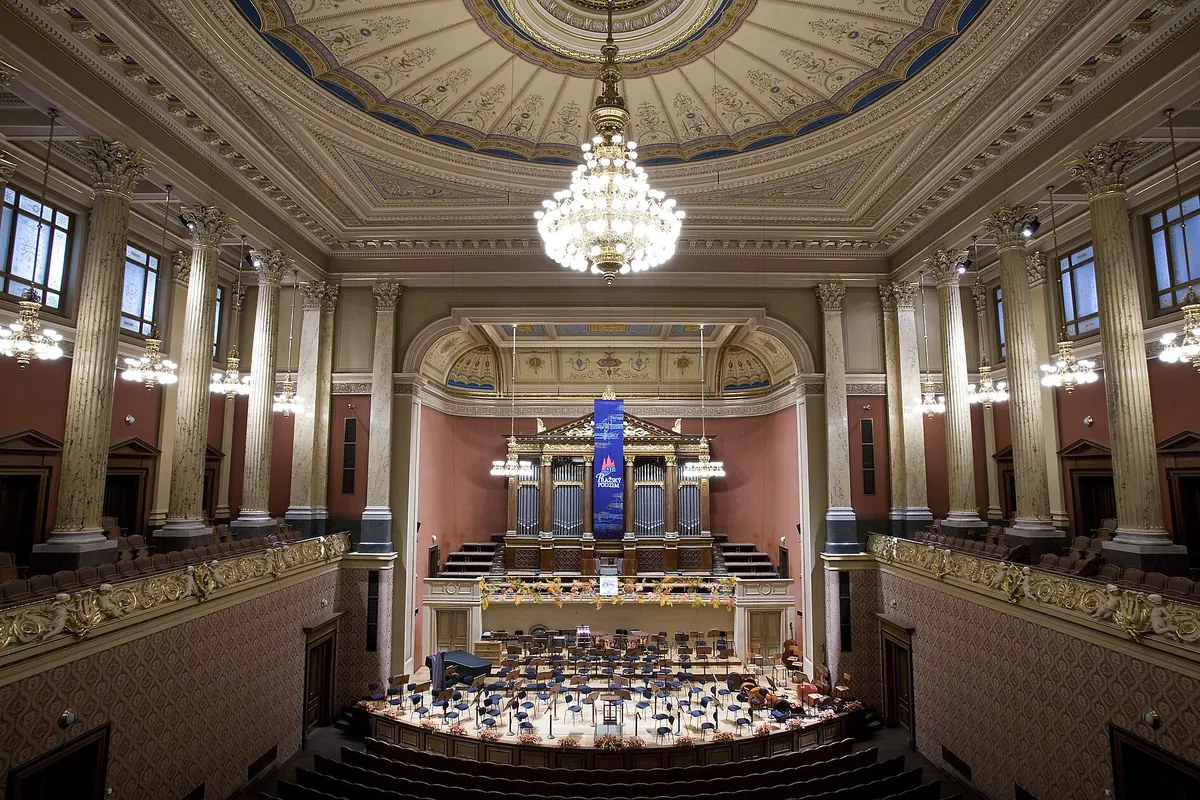
Wikipedia explains that Renaissance Revival, also called neo-Renaissance, is a group of nineteenth-century architectural styles that drew on a wide range of Renaissance models, neither Greek Revival nor Gothic Revival. The label covers buildings as different as an Italian palazzo and a French chateau, so it describes an attitude more than a recipe. On the street, that means a front of ordered arches and windows, symmetry and carved detail, rather than Gothic spires or baroque swirl. The Rudolfinum is one of the best-known Prague examples, and Wikipedia describes it simply as designed in the neo-Renaissance style, on the bank of the Vltava.
Two architects, one teacher and one student
The architect Josef Zítek was, according to Wikipedia, best known for two neo-Renaissance landmarks in Prague, the National Theatre and the Rudolfinum. He taught at the Prague Polytechnic, where his pupils included Josef Schulz, with whom he later collaborated. The Rudolfinum was Zítek's last design to be completed, finished in 1884 and done in cooperation with Schulz, who had completed the National Theatre's reconstruction after its fire. The building therefore sits at the end of one career and the start of another, and it opened to the public on 8 February 1885.
A prince's name
The Rudolfinum is named in honour of Rudolf, the crown prince of Austria, who presided over the opening, according to Wikipedia. Prague then belonged to the Austro-Hungarian Empire, and naming a landmark for the heir to the throne was a conventional gesture of the time. The name has outlived the empire, and today it simply identifies the building.
A parliament and a gallery
Between 1919 and 1939 the building served as the seat of the Czechoslovak parliament, the Chamber of Deputies sitting in the first republic's years. Since 1946 it has been the home of the Czech Philharmonic. It also contains Galerie Rudolfinum, an art gallery that Wikipedia says focuses mainly on contemporary art, opened on 1 January 1994 and has no collection of its own, running on the Kunsthalle principle with temporary exhibitions. A concert ticket does not cover the gallery, so check its own page if you want to visit.
The square around it
The Rudolfinum stands on the north side of Jan Palach Square, in the Old Town on the right bank of the Vltava. Wikipedia says the Mánes Bridge connects the square to Malá Strana and that the river side offers a good view of Prague Castle, Petřín Hill and Charles Bridge. A statue of the composer Antonín Dvořák stands in front of the building. Charles University's Faculty of Arts holds the eastern flank, while the southern building belongs to the Academy of Arts, Architecture and Design. The setting makes the concert easy to pair with a riverside walk.
Frequently asked questions
Who designed the Rudolfinum?
Josef Zítek with his student Josef Schulz, says Wikipedia.
When did it open?
On 8 February 1885, with Crown Prince Rudolf presiding, according to Wikipedia.
Is it only a concert hall?
No. It also houses Galerie Rudolfinum, a contemporary art gallery.
Is the building really named for a prince?
Yes, for Rudolf, the Austrian crown prince, who presided at the opening.
Sources